Remember Station Wagons? Theyre Back Again
Our auto experts cull every production nosotros characteristic. Nosotros may earn money from the links on this folio.
Wayback Machines: Station Wagons That You Forgot Ever Existed
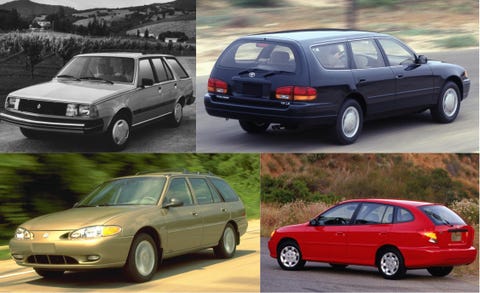
Before minivans so SUVs took over the utility-vehicle market in the 1980s and 1990s, station wagons were a dime a dozen, being the de facto choice for those with families or those looking for more practicality from their daily driver. As such, many wagons such as the Volvo 240 and the Ford Country Squire have reached iconic status over the years, whether it be on the virtue of distinctive blueprint or pop-culture recognition.
But we reckon that there are enough of wagons offered over the past few decades that y'all forgot even existed. Then we dug up a list of 26 wagons that have slipped through the cracks; all were sold in America inside the terminal 30 years or so, although you'd exist hard-pressed to run into many of these puttering around your neighborhood today.
1 of 42
Acura TSX Sport Wagon
For 4 glorious model years, Acura's showroom floors were graced with the TSX railroad vehicle. The slinky hatchback entered our market in the 2011 model yr with a i-size-fits-all arroyo, limiting buyers to Acura'south rev-happy 201-hp 2.4-liter inline-iv mated to a 5-speed automatic. Sadly, the TSX sedan's crisp six-speed transmission was left off the card, as was its optional 280-horse 3.5-liter V-half-dozen.
2 of 42
Acura TSX Sport Carriage
Although the forepart-wheel-bulldoze TSX wagon wasn't peculiarly quick (we clocked a zero-to-60-mph fourth dimension of 8.ane seconds), the railroad vehicle's 200 or and so actress pounds of weight over its sedan counterpart had no effect on the TSX'south communicative steering, agile handling, and fantastic brake-pedal feel. We're not certain if TSX wagons are so hard to come by today because Acura sold then few of them or considering owners are so reluctant to turn over the keys to this fun-to-bulldoze and versatile vehicle. Probably a piffling of both. —Greg Fink
iii of 42
Daewoo Nubira Railroad vehicle
At the dawn of the millennium, there were more than than 200 Daewoo dealerships in 42 states. By 2002, when the broke Daewoo Motor America packed up for South Korea after 5 aggressive years, there were 525. Unless you lived surreptitious, you could take bought a new Nubira wagon as hands as you could buy a Kit-Kat bar. Past contemporary standards, the Nubira was a fine-riding, roomy compact auto that nevertheless looks decent from the outside.
5 of 42
Contrivance/Plymouth Filly DL Wagon
Although the tall-motorcar/small-minivan vehicle sold as the Filly Vista was more popular, the fifth generation of the Colt range—and so based on the Mitsubishi Mirage—besides included this conventional station wagon, which lasted from 1988 until 1991. For drivers, it was more appealing than the equivalent sedan and hatchback models on two grounds: First, the base version came with multiport fuel injection for its SOHC one.v-liter inline-iv and fabricated a whopping 75 horsepower while other models settled for a two-barrel carburetor and but 68 ponies. Second, the railroad vehicle had a three-link abaft-arm independent rear suspension in place of the other model's torsion beam. Downside? You couldn't have the turbocharged i.6-liter that was an option on the hatchback, although carriage customers still had a choice of a v-speed manual transmission (i gear more than than was mutual to Colts in the era), which made it much livelier than did the optional three-speed automated. A split-folding rear seat allowed up to 60 cubic feet of cargo capacity in a vehicle that was 0.5 inch shorter than today's Mini Countryman on a 93.vii-inch wheelbase, nearly a human foot shorter than the Mini'southward. When considering the pocket-sized power output, though, remember that this wagon weighed only 2271 pounds—or roughly 1000 pounds less than the front-bulldoze version of the Countryman. The Colt DL railroad vehicle also could exist had with four-bike drive. —Kevin A. Wilson
6 of 42
Eagle Medallion Wagon
Originally sold as the Renault Medallion through AMC dealerships, this French railroad vehicle swapped names after Chrysler purchased AMC and subsequently created the Eagle brand. Beginning in model year 1988, Eagle dealers officially sold the Medallion sedan and wagon as 1 of their own.
seven of 42
Eagle Medallion Wagon
The 189.7-inch-long wagon offered an optional third-row seat, and information technology came standard with a two.2-liter inline-4 packing 103 horsepower and 124 lb-ft of torque mated to a standard five-speed transmission or an optional three-speed automatic manual. Sadly, the Hawkeye Medallion wagon, similar Eagle itself, was short lived, helping spell the end for French cars on American roads for many years to come. —GF
8 of 42
Ford Escort/Mercury Tracer Wagon
Earlier the Focus took over as Ford's global meaty in the 2000s, the Escort was the Blue Oval'due south modest automobile of note throughout the 1980s and 1990s. During its 3 generations in America, the Escort—and its Mercury sibling, starting time called the Lynx, and then the Tracer—ever included a wagon in its lineup, until 1999 when the Escort was put to pasture. It's hard to say which of these wagons is most forgettable, just we tin can't remember the concluding fourth dimension we saw any Mercury Tracer, allow alone a carriage.
9 of 42
Ford Escort/Mercury Tracer Wagon
The Mercury's timeline wasn't exactly in sync with the Ford'south, every bit the Tracer nameplate first appeared on a rebadged Mazda 323 in the late 1980s earlier existence applied to an Escort twin starting in the 1990s. The 2nd- and third-generation Escorts and Tracers, too, were substantially Mazdas underneath, sharing the ubiquitous Mazda B platform that underpinned a broad range of compact cars throughout the globe, including the Mazda Protegé and even the Kia Sephia. —Joseph Capparella
ten of 42
Ford Focus Carriage
While Europeans can even so walk into a Ford dealer and drive out in a new Focus wagon, it has been a decade since Americans were offered the aforementioned privilege. When the first-generation Focus launched for 2000, resplendent in the make's New Edge pattern language, information technology was a rather revelatory vehicle from an American manufacturer, offering a spot of Euro-fashion driving fun during a time when American compacts either felt tinny (Chrysler's Neon) or ancient (GM'southward Condescending and Sunfire). Ford fifty-fifty saw fit to bring over a carriage variant. Regrettably, while the Blueish Oval kept the Focus competitive overseas, we continued to be offered the first-generation cars through the 2011 model year. Our first-gen Focus saw a couple of increasingly unfortunate refreshes, the 2d of which saw the wagon depart from our shores after the 2007 model year. —Davey G. Johnson
11 of 42
Geo Storm Wagonback
One of the more shooting-brakey forgotten wagonoids to make our list, the 1991–1992 Geo Storm Wagonback was a funky-fresh take on the Isuzu-produced sport meaty. Available only with the Storm'due south base of operations, 95-hp engine, the tailgate-party-friendly have on the rebadged Impulse bridged the gap of the Storm's mild mid-wheel refresh.
12 of 42
Geo Tempest Wagonback
The 1991 models featured the semi-pop-up headlamps that debuted on the car, while 1992 Wagonbacks received the less distinctive, Pontiac-fashion gun-slit lights. The Tempest carried on for a twelvemonth later on the Wagonback's divergence. —DGJ
13 of 42
General Motors J-body Wagons (Chevrolet Cavalier, Pontiac Sunbird, Oldsmobile Firenza, Buick Skyhawk)
Cadillac's Cimarron may accept been the virtually infamous model built on GM's J-body platform, simply the budget Caddy never spawned a wagon. Developed prior to Chrysler's minivans that were introduced for 1984, the J-based wagon was featured by every other General Motors brand. Oldsmobile offered the Firenza, Buick dealers sold a Skyhawk carriage, while Pontiac pitched its J wagon under the names J2000, 2000, and Sunbird. No J car, nevertheless, outsold the Chevrolet Condescending, and its wagon variant stayed in production the longest—through 1994.
14 of 42
General Motors J-trunk Wagons (Chevrolet Cavalier, Pontiac Sunbird, Oldsmobile Firenza, Buick Skyhawk)
It may be a stretch for some readers to remember that the J-bodies seemed fresh and fifty-fifty competitive in the early 1980s; with their vibration-prone engines and hokey, squared-off instrument panels, the machines were certainly a product of hubris. But the original Firenza and Skyhawk wagons offered legitimately sharp styling for the fourth dimension, while the Cavalier and Sunbird at least looked contemporary. A decade on, yet, the Cavalier wagon was looking decidedly dated, something repeated exterior refreshes hadn't helped. When it came fourth dimension to redo the Cavalier for 1995, the wagon went the way of the dodo. The dodo, reportedly, was dismayed past the Cavalier'south presence in its domain. —DGJ
fifteen of 42
Honda Civic Wagon
The square-back, 4-door Civic introduced in 1985 was really more of a tall hatchback than a carriage, simply it had "wagon" in its name, so here information technology is. (In some model years the car was called the Civic Wagovan.) Offered during two generations of Civic and based on the sedan's platform, the wagon featured a tall, chubby body with high-mounted seats and generous window surface area.
16 of 42
Honda Civic Railroad vehicle
In many ways the Civic wagon is like today's Honda Fit (although the erstwhile is even smaller than the latter). Both pack a lot of interior space into tiny bodies, and both feature multiposition, fold-flat rear seats. The 2 even employ identically sized 1.5-liter engines, although the old wagon's 76 horsepower pales in comparing to a mod Fit's 130 ponies—and Honda saw fit to offer the carriage with a neat all-bike-drive setup. —Alexander Stoklosa
17 of 42
Jaguar Ten-type Sportwagon
When the XF Sportbrake finally shows up, it won't be the first station carriage from Jaguar, nor even the offset sold in America. Betwixt 2005 and 2008, Jaguar offered this wagon edition of the X-type sedan. Over those four model years, Jag sold a grand total of 1602 units here. Chosen the X-type Sportwagon, its biggest trouble was shared with the sedan—it was really a Ford Mondeo, which had previously appeared in the U.Due south. under the proper noun Contour. A bit of leather hither, a chunk of wood at that place, four headlamps arranged only and so, and, presto! Information technology's a Jaguar. With Ford'southward 3.0-liter Duratec V-6 underhood coupled with a 5-speed automatic and standard all-bike drive, information technology was good for a seven.eight-2nd zero-to-threescore-mph run in our tests. We suppose it might make a nice used motorcar today, if you lot tin find ane, just don't count on hauling a lot of stuff in it: With the rear seats folded down (they split seventy/30), information technology offers merely fifty cubic anxiety of cargo hold. At least it has more rear headroom than the sedan. —KAW
18 of 42
Kia Rio Cinco
Back when Kias withal sold largely on their used-car prices and yet were covered by new-machine warranties, the Rio appeared. That was for the 2001 model twelvemonth. A year after, a Rio wagon dubbed the Cinco was introduced. The 2 Kias shared a wimpy 96-hp 1.v-liter inline-four engine and their front-end styling, such every bit it was.
19 of 42
Kia Rio Cinco
A wagon body, nonetheless, greatly improved the Rio'south entreatment. Not only did the small longroof look nearly sleek, information technology could concur more stuff. A refresh for 2003 upped engine output to a raging 105 horsepower and modernized the styling somewhat, neither of which changed the Rio's station every bit one of the cheapest new cars available in the Us. —AS
20 of 42
Lexus IS300 SportCross
Lexus has always been laser focused on the American luxury market, which probably explains why information technology never truly dipped its toes in the station-carriage pool dominated by European firms such equally Mercedes-Benz and Volvo. The bizarre IS300 SportCross, in fact, is the but wagon Lexus has ever sold. Information technology was part of the first-generation IS lineup, joining the IS300 sedan that was Toyota's commencement legitimate attempt at taking on the BMW three-series.
21 of 42
Lexus IS300 SportCross
An attractively proportioned little wagonlet, the SportCross shared most everything with the sporty sedan, including its taut rear-wheel-drive chassis and its silky inline-six engine making 215 horsepower. Alas, only an automatic transmission was available, preventing the SportCross from becoming a true enthusiast's special. Simply around 3000 buyers snapped upward the SportCross during its run from 2002 to 2005, so when the IS was redesigned for 2006, no one was surprised to learn that this wagon variant had reached the end of the line. —JC
22 of 42
Mazda half dozen Wagon
You may take forgotten most the original Mazda half-dozen wagon, but we certain haven't. That'south considering the sporty longroof 6 came only with the 220-hp 3.0-liter 5-6 that was optional on the sedan and—wait for it—had a 5-speed manual manual as standard.
23 of 42
Mazda 6 Wagon
An automated was optional, if you lot didn't similar to have as much fun. Imagine today'south Mazda 6 in carriage class, with a stick shift and the CX-9's turbocharged inline-iv engine . . . —AS
24 of 42
Mitsubishi Diamante Wagon
Mitsubishi, a pioneer of torque vectoring, 4-cycle steering, and electronic trickery well beyond the general motorcar industry, wanted to beat Acura and Lexus in the early 1990s. Every bit we knew so and now, it had nil risk of doing that. Simply the first-gen Diamante, particularly the Australia-congenital station wagon, moved Mitsubishi into a most-luxury category it would cling to until the last, drastic 2004 model. The wagons could consume 72 cubic anxiety of cargo with the rear seats folded and were generally regarded as competent in any measure out. But Mitsubishi never gave our Diamante anything to push it across the competition, despite Japan-market cars employing 5-speed automatics, all-wheel drive, laser-based adaptive cruise control, and higher-output 5-vi engines. The indistinct styling and budget bluecoat did the Diamante no favors among customers who preferred to spend their $thirty,000 on a new Volvo 850 wagon. —CA
25 of 42
Mitsubishi Lancer Sportback
Set bated the loftier-performance Evolution, and the Mitsubishi Lancer has lived a largely forgettable office. This is particularly true of the new-for-2002 generation that was boring to look at and not much more than exciting to bulldoze. Things improved little for the 2004 model year when Mitsu added a railroad vehicle variant dubbed the Sportback. Measuring 181.3 inches long, the Lancer Sportback was able to consume 25 cubic feet of goods with the rear seats in identify. 2 trims were offered: the dowdy LS and the slightly more heady Ralliart. Both came standard with a 2.4-liter inline-4, the LS pumping out 160 horsepower and the Ralliart 162. Both were saddled with a iv-speed automatic transmission. The Sportback lasted ane unabridged model year in the U.S. marketplace. —GF
26 of 42
Nissan Maxima Wagon
The second-generation Maxima of 1985 was nigh duplicate to the centre from the car it replaced, although a peek under the peel revealed changes that fundamentally altered the marque's 4-door sports car. The new car brought front-bicycle drive and a modern, transversely-oriented V-6 lifted from the 300ZX that replaced the old inline-half dozen that had ties to the 1969 Datsun 240Z. The new carriage boasted 63 cubic feet of cargo capacity with its rear seats folded down, 49 cubes more than than the sedan's trunk and two more than today's Rogue Sport crossover. —Duncan Brady
27 of 42
Nissan Sentra Carriage
The Nissan Sentra is all-time remembered for the standout B13 generation sold in the early 1990s, the sporty SE-R version of which landed on our 10Best Cars list from 1991 to 1994. But in that location were actually two generations of the Sentra sold in the U.S. earlier that memorable automobile. The second generation, which arrived in the mid-1980s, was the concluding Sentra to offering a wagon as function of the lineup. Its rectilinear shape made for a somewhat bizarre-looking longroof body fashion, with a curiously sloped liftgate and not a single curved surface to be found. Every bit was the trend among other small Japanese wagons at the fourth dimension, such as the Toyota Tercel and the Honda Civic, this Sentra was offered with a selectable four-bike-drive system with a transfer case—but you lot'd be hard-pressed to notice i of those rare birds today. —JC
28 of 42
Peugeot 405 Sportswagon
While the French automaker's long-wheelbase 505 wagon wasn't an entirely uncommon sight in tonier suburbs in the belatedly '80s, the 405 carriage is a model that fifty-fifty dedicated Francophiles might not recall. The smaller, front-bicycle-bulldoze 405 sedan arrived every bit an sometime BMW three-series competitor in 1988, only three brusk years earlier Peugeot would quit united states forever.
29 of 42
Peugeot 405 Sportswagon
The side by side twelvemonth, the sedan was accompanied by a railroad vehicle. Designed by Pininfarina, it used the same 110-hp four-cylinder engine, 4-wheel independent intermission, and four disc brakes merely was denied the sedan's hotter, 150-hp Mi16 variant. —Joe Lorio
30 of 42
Renault Sportwagon
Renault's tie-upwardly with American Motors is all-time remembered for bringing u.s.a. the Wisconsin-built Renault Alliance, which we named to our 10Best Cars listing in 1983—and after regretted doing and so. But Renault did sell other cars in the States during that five-year period from 1982 to 1987, before the French nameplate exited our market for good. Nearly of these '80s American Renaults disappeared without a trace, perhaps none more and so than the Sportwagon, which was a tweaked version of the mid-size Renault 18.
This content is created and maintained by a third party, and imported onto this folio to help users provide their email addresses. Y'all may be able to discover more data nigh this and similar content at pianoforte.io
whitakerbeyea1975.blogspot.com
Source: https://www.caranddriver.com/features/g15085156/wayback-machines-station-wagons-that-you-forgot-ever-existed/

Postar um comentário for "Remember Station Wagons? Theyre Back Again"