The Holocaust Childrens Art the Story of Friedl Dickerbrandeis and the Children of Terezin
WHEN the Jews were deported to Theresienstadt ghetto from Prague and environs in 1942, they were instructed to bring with them merely 50 kilos. The dilemma of how to pack into a suitcase one's unabridged past life for an unknown time to come life must take been a daunting one. What to bring? Most deportees packed clothing, household articles, valuables, photograph albums and the similar. However, artist and teacher Friedl Dicker-Brandeis used her weight assart in a different way. After packing a few necessary items of habiliment, she chose to fill up the rest of her weight quota with fine art supplies. Her purpose was not to but have material for her own creative needs, but to ensure that she would have the necessary art supplies on mitt to teach art to the hundreds of traumatized children whom she predictable meeting at journey's end. This determination was a natural part of who Friedl Dicker-Brandeis was. While nigh of us can relate to the very homo survival instinct of self preservation, of providing first and foremost for oneself and ane'south family, her choice to give of herself to others - to donate her time, her talents and her indomitable spirit – is a much rarer quality, 1 that nevertheless has the power to captivate and inspire united states of america 70 years later.
Friedl was born in 1898 in Vienna, Austria. She was a little girl who lost her mother at a very early age, a loss which she felt keenly her entire life. Although she and her husband, Pavel Brandeis, never had any children of their own, in Theresienstadt Friedl was finally able to give free rein to her maternal instincts, and to nurture, and teach hundreds of children who saw her as a surrogate female parent.
From an early age, Friedl pursued a life of fine art and creativity. She studied in the Weimar Bauhaus nether such luminaries as Johannes Itten and Paul Klee. The Bauhaus was not merely a design university, but an entire philosophy, based on the aesthetics of empathy. Its students were encouraged not to arroyo an object or subject as if they were a camera, aiming to merely depict the shallow outer shell, just rather to seek the field of study's essence, to see it both inside and out, to become one with their subject, to empathize with it. This philosophy would become the core of Friedl'south own artwork and her guiding principle for teaching fine art to children, a calling that would come into its own in Theresienstadt.
In mid 1938, Friedl had obtained Czech citizenship and she and her husband, Pavel Brandeis were living in Harnov, Czechoslovakia. It was from there that they were deported to Theresienstadt, on Dec 17th, 1942.
Weather in Theresienstadt were appalling, and even more and so for children who had to first cope with the enormous trauma and life-changing upheaval that deportation wreaked upon their young lives. The Czech children who were deported to Theresienstadt had slept in their beds until the mean solar day they were deported, and were together with their immediate families until the moment they arrived. Children were ripped abroad from the familiarity of their homes, families, communities and routines and thrust into a terrifying new reality which they could non understand. Upon arrival in Theresienstadt, children were forcefully separated from their parents and family and sent to live alone in overcrowded children's houses; even brothers and sisters were separated because boys had to live separately from girls. The starvation, disease and brutality of Theresienstadt, forth with lack of stability and construction, put an enormous strain on the coping mechanisms of these children. They desperately needed direction and purpose, and Friedl was there to requite them that.
Realizing that art could be a therapeutic tool to assist children to deal with their feelings of loss, sorrow, fear, and uncertainty, Friedl set almost educational activity over 600 children with the enormous enthusiasm and energy that her friends, colleagues and students retrieve every bit beingness so typical for her. Using the limited art supplies she had brought with her to the ghetto, she had her students explore diverse mediums such as collage, watercolor painting, paper weaving, and drawing. But her lessons were not designed merely to teach her students technique. Rather, these unlike techniques became the means through which she taught her immature students to dig beneath the facile to the deep well-spring of their feelings and emotions, and from that intimate place, to create. Through this intuitive method, a drawing of a flower vase on a windowsill, or the portrait of a child, would go something truly absorbed, securely felt, sublime. It would reflect the child's inner feelings - a window into their soul. In a lecture she gave in the ghetto in 1943 to explain her pedagogy methods, she declared that her purpose was not to train the children every bit artists, only rather to "unlock and preserve for all the creative spirit equally a source of energy to stimulate fantasy and imagination and strengthen children'south power to gauge, appreciate, observe, [and] endure" by helping children choose and elaborate their own forms."1
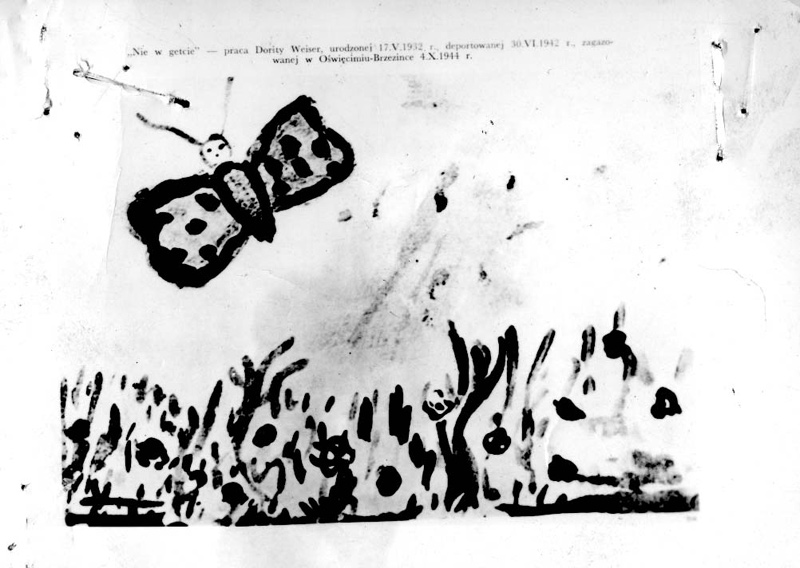
Theresienstadt, Czechoslovakia, A painting entitled "It'southward Not in the Ghetto", by Dority Weiser
Friedl respected the dizzying imagination of children, and did not try to adjourn her students with developed restrictions, but tried rather to harness that imagination and permit it move them. For Friedl, artwork represented freedom, and that freedom could take her students outside the boundaries of their prison, outside of the horror and oppression that was their daily reality. One of Friedl's few students that survived the Holocaust, Helga Kinsky (nee Pollak), recalls how under Friedl'due south tutelage, the children did not depict the misery and horror that surrounded them, only rather that Friedl "transported us to a different world…. She painted flowers in windows, a view out of a window. She had a totally different approach…. She didn't make u.s.a. draw Terezin."two
Some other surviving student, Eva Dorian said of her beloved teacher: "I believe that what she wanted from us was not directly linked to drawing, but rather to the expression of different feelings, to the liberation from our fears…these were not normal lessons, merely lessons in emancipated meditation"iii.
None of these attempts of art as therapy, of spiritual liberty through paints and paper, could change the dreadful reality that awaited the majority of the Jews of Theresienstadt. When Friedl's husband Pavel was deported from Theresienstadt in tardily September 1944, she voluntarily signed upwardly for the next ship, desperate to reunite with him. But what was to become of her collection of the children'southward precious artwork and her ain beautiful drawings and paintings? Hoping that optics more sympathetic than the Nazis' would 1 day encounter them, she packed v,000 pieces of artwork into the aforementioned 2 suitcases they had arrived in equally raw materials in 1942, and hid them, to be found after the state of war. Although Friedl herself did non sign most of the piece of work she produced in Theresienstadt, she made sure that the children signed their creations with their name and age, a testimony to their identity, a document of their existence. These drawings and signatures are all that remains of near of Friedl's 600 students. Apart from their ages and names, the overall bulk will remain forever unknown, murdered in the gas chambers of Auschwitz Birkenau, starved to decease in Theresienstadt or killed by the inhuman weather of other camps.
On October 6th, 1944, Friedl Dicker Brandeis and 60 of her students were sent on transport number EO 167 to Auschwitz Birkenau, where most of them were probably murdered upon inflow. Until the very end, Friedl did not resign herself to despair or allow her young students to go engulfed by hopelessness. Rather, equally one of the first practioners of art therapy, she gave them the gift of expression, artistic freedom and beauty and helped give meaning to their young lives, for as long equally they still had to alive. I of her former students sums upwardly succinctly what Friedl meant to her:
"Friedl's pedagogy, the times spent drawing with her, are among the fondest memories of my life. The fact that information technology was Terezin fabricated it more than poignant but information technology would have been the same anywhere in the world… I think Friedl was the only ane who taught without ever asking for anything in return. She just gave of herself."4
Through her solidarity with those in need, the giving of herself to aid others to cope, Friedl Dicker-Brandeis – creative person, teacher, and spiritual mother – inspires us every bit much today equally she did her own students seventy years agone.
whitakerbeyea1975.blogspot.com
Source: https://www.yadvashem.org/articles/general/coping-through-art-brandeis-theresienstadt.html

Postar um comentário for "The Holocaust Childrens Art the Story of Friedl Dickerbrandeis and the Children of Terezin"